Tag Archives: Study

Weight Loss Study Information & Resources

There are countless weight loss studies around. Scientists and corporations never get tired of analysing every aspect of the human condition. On this page you’ll find information and resources relating to the weight loss study.

Body Mass Index (BMI) Flaws Mean a Piece of String Could Work Better

Since its inception body mass index or BMI for short has been the yard stick test for measuring body fat. New research (and a piece of string) now shows that it’s in no way a perfect science.

Body Mass Index test has been around for quite a while now. For some time we have known it is not a perfect method for measuring body fat but it’s been agreed that it can be used as suitable guideline to help with obesity and weight loss. New research by Dr. Margaret Ashwell and Oxford Brookes University has now fully exposed the flaws of BMI using a piece of string as visual aid.

BMI test quick facts.

BMI was conceived in the early 1800’s by Belgian Polymath Adolphe Quetelet. He came up with the formula which is used as a test for measuring obesity which he called the Quetelet Index of Obesity. This was then fine tuned into the following formulas:

  1. Imperial English BMI – weight (lbs) x 703 ÷ height (in2)
  2. Metric BMI – weight (kg) / height (m2)

BMI has only been used as a global standard since the 1980’s when there was a rise in cases of obesity across the western world.

Start Your Weight Loss Journey Today!

Get in touch today for a free consultation with a weight loss specialist.

Quick contact form

    Start Your Weight Loss Journey Today!

    Full name: (required)

    Your email: (required)

    Your telephone:

    Choose your nearest clinic:

    Additional comments:

    Email us: kingsweightloss@gmail.com
    Call us: 0208 597 4321

    The trouble with Body Mass Index (BMI).

    The problem with Body Mass Index (BMI) is a two-fold problem that can’t account for important body shape variables. For example, if a person is exceptionally muscular such as a bodybuilder, the standard BMI calculator will show them as being overweight or obese. You only have to look at them to realise how far off the mark is kind of assessment is.

    “BMI gives us an idea of total fat mass, but doesn’t tell us where the fat is located in our body,” “Fat distribution can give us an idea of whether a person is at an increased risk of mortality.” W. Scott Butsch – MD Harvard Medical School

    The other more significant problem is that if a person is a fairly standard shape all over but has a lot of belly fat the current BMI test may give them the all clear from a weight loss perspective. This means a lot of people are not being diagnosed properly and never receiving the treatment they need.

    “If you are measuring waist-to-height ratio you are getting a much earlier prediction that something is going wrong, and then you can do something about it.”Dr. Margaret Ashwell – Oxford Brookes University

    BMI string test and WHtR (waist-to-height ratio).

    In a new weight and health assessment study conducted in Oxford Brookes University a new method has gained a lot of ground. WHtR (waist-to-height ratio) which can be conducted with a piece of string has been shown as a test to be a much better indicator of a person’s weight status and possible obesity.
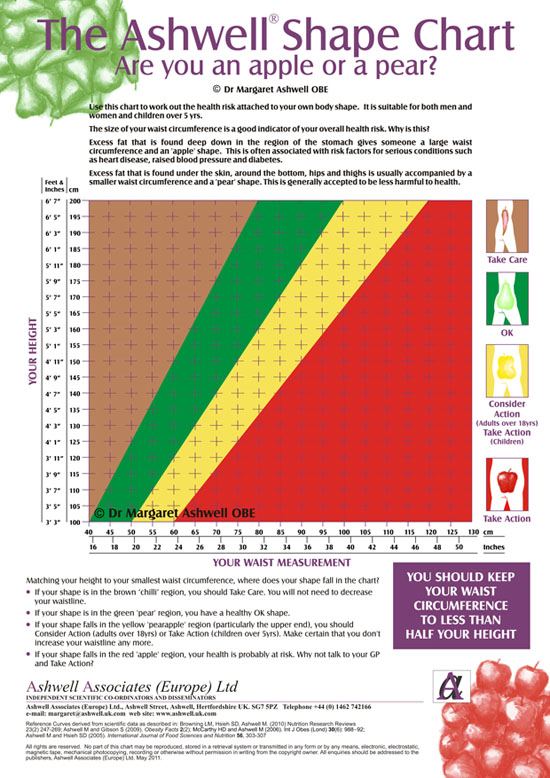
    Ashwell Shape Chart - Alternative to Body Mass Index Chart
    Ashwell Shape Chart – Alternative to Body Mass Index Chart

    The problem is that white fat which generally gathers around the waist can be missed by a regular BMI test. With WHtR (waist-to-height ratio) you measure your height with a piece of string and then fold the string in half and wrap it around your waist to see if it will comfortably fit your circumference. If you fail the string test you should consider seeing your GP or attending a weight loss clinic.

    “The beauty is that you can do it in centimetres or inches, it doesn’t matter. We have got increasing evidence that this works very well with children as well, because whilst they grow up their waist is growing but also their height.” Dr. Margaret Ashwell – Oxford Brookes University

    The study of 3000 people showed that at least 12% of people suffering from obesity or being overweight would be completely missed using the current BMI method.


    Weight Loss Study Reveals Exercise Alone Won’t Help You Lose Weight

    The British Journal of Sports Medicine has recently released a weight loss study that outlines why exercising regularly isn’t enough to fight off obesity.

    It’s commonly known that a diet high in fat, carbohydrates and sugars is bad for you. It’s also commonly known that regular exercise is good for you. What isn’t commonly known is a regular exercise will not combat the effects of a bad diet on system.

    Many people still believe they can eat what they like as long as they exercise regularly. Many people think that being a bit overweight doesn’t really matter if they’re getting regular exercise. This new weight loss study aims to ‘bust the myth’ that regular exercise can tackle obesity and the health effects of being overweight.

    In a recent editorial the British Journal of Sports Medicine has said that ‘you can’t outrun a bad diet’. Exercising regularly, although helpful in reducing the risk of type 2 diabetes, heart disease and dementia, what it doesn’t do is promote weight loss.

    [one_half][responsive]British Journal of Sports Medicine recent weight loss study[/responsive]

    [/one_half] [one_half_last]

    [box style=”2″]

    UK obesity statistics.

    [list]
    [list_item icon=”remove-sign”]Massive increase in the last 8 years[/list_item]
    [list_item icon=”remove-sign”]One in 4 adults in England obese[/list_item]
    [list_item icon=”remove-sign”]A further 42% men are overweight[/list_item]
    [list_item icon=”remove-sign”]The overweight/obese figure for women is 32%[/list_item]
    [list_item icon=”remove-sign”]A BMI of 30-35 cuts life expectancy by up to 4 yrs[/list_item]
    [list_item icon=”remove-sign”]A BMI 40+ cuts life expectancy by up to 10 yrs[/list_item]

    [/list]


    Source: National Institute of Health and Care Excellence[/box][/one_half_last]

    “Yes, companies are taking action to highlight the importance of physical activity. However, they recognise that where they can have the biggest impact is in helping people to achieve a balanced diet,” – they say.

    Busting weight loss myths.

    The weight loss study is designed to highlight key messages that have been misinterpreted by the general public. Messages such as those being used by the food industry to blame consumers for being overweight have been targeted by the study. The general message from the junk food industry is that obesity and being overweight is caused by a lack of exercise. The weight loss study found that this is generally not the case.

    Sugar criticism.

    The study also criticises the connection between junk food and sport calling for an end to the informal partnership. Going further it calls for a sugar tax on high sugar drinks and a wholesale ban on junk food advertising in gyms. They say that the food industry have shifted the debate to calorie counting alone which doesn’t take into account the origin of the calories. They argue that sugar calories promote fat storage and encourage feeling hungry.

    Weight Loss – New Hormone Discovered that can Mimic Exercise Benefits

    Scientists have recently discovered a certain hormone can help treat weight loss, obesity and type 2 Diabetes by mimicking the effects of exercise.

    Scientific researchers based at USC Leonard Davis School of Gerontology have recently discovered a new hormone. Dubbed “MOTS-c” the hormone is unlike any other hormone discovered so far and has the ability to target muscle tissue and restore insulin sensitivity and normalise the metabolism.

    Changhan Lee, the study’s other lead author, explained:This discovery sheds new light on mitochondria and positions them as active regulators of metabolism.”

    MOTS-c can apparently combat the usual weight gains that are typically inherent in a high-fat diet. The apparent benefits can be similar to that of a physical exercise regime. The hormone reacts with the body’s insulin to counteract diet-induced or age-dependent insulin resistance and nurtures effective processing of glucose sugars.

    [box style=”2″]

    What are hormones?

    Hormones are molecules inside the body that act as signals. They are associated with triggering a range of physiological responses.

    Examples of where hormones are secreted from:

    [one_half]

    • Pituitary gland
    • Pineal gland
    • Thymus
    • Thyroid

    [/one_half] [one_half_last]

    • Adrenal glands
    • Pancreas
    • Testes
    • Ovaries

    [/one_half_last]

    More information on hormones: http://www.news-medical.net/health/What-are-Hormones.aspx

    [/box]

    The extensive study was carried out on a test group of mice which had been fattened up to obesity levels first. Once the hormone was injected into the mice their weight gain decreased and the insulin resistance which was also caused by the poor diet was reversed. The study was published Cell Metabolism.

    The conclusions drawn have pointed to the development of new ways to combat obesity and type 2 diabetes. This is because of the closeness to humans of the physical mechanisms tested. Of course additional research will be needed but Dr. Pinchas Cohen has indicated human trails could begin with 3 years.

    Dr. Pinchas Cohen, senior author of the study, said:This represents a major advance in the identification of new treatments for age-related diseases such as diabetes.”

    Diabetes affects an estimated 380 million across the globe so any good news on easing the problems that arise as a consequence are very welcomed.

    New UK Weight Loss Study Shows Frequent Eating Complete Myth

    Small and often has been a weight loss mantra for as long as we can remember. However this idea was recently exposed as the myth it is by a study carried out by the UK University of Warwick.

    The study found that eating small meals frequently does not encourage weight loss or (as was once thought) provide a boost to the body’s metabolism. What was discovered was the ultimately healthy weight loss all comes down to counting the calories.

    The UK researchers examined and studied 24 obese and lean females on separate days. The women were given either 2 or 5 meals over a 24 hour period which consisted of the same amount of calories to be consumed inside the 24 hour period. Test conducted at the end of each day revealed that the obese women eating 5 smaller meals actually ‘accumulated significantly higher levels of endotoxins’ than the women eating only 2 meals a day.

    Start Your Weight Loss Journey Today!

    Get in touch today for a free consultation with a weight loss specialist.

    Quick contact form

      Start Your Weight Loss Journey Today!

      Full name: (required)

      Your email: (required)

      Your telephone:

      Choose your nearest clinic:

      Additional comments:

      Email us: kingsweightloss@gmail.com
      Call us: 0208 597 4321

      The researchers were looking for evidence on whether the consumption of multiple meals could expose an obese patient to increased risk of type 2 diabetes and cardiovascular disease. In previously conducted studies it has been shown that eating a high fat meal can cause low-level inflammation. It’s that low-level inflammation that has been shown to be linked to type 2 diabetes and cardiovascular disease.

      Dr. Piya says their weight loss research has yielded two main findings:

      “Firstly, that the size or frequency of the meal doesn’t affect the calories we burn in a day, but what matters most for losing weight is counting calories. Secondly, by carrying more weight, more endotoxin enters the circulation to cause inflammation, and eating more often will exacerbate this risk, which has been linked to metabolic diseases such as type-2 diabetes.”

      The weight loss research was presented at the Society for Endocrinology annual BES conference in Liverpool.