Tag Archives: Obesity

Obesity Posts & Related Weight Loss Articles

Read our posts on obesity and other weight loss related subjects. Obesity and weight loss is an important topic which is loved and hated by many. We regularly update this section of the website to ensure you get informative, up-to-date information on industry related topics.

Weight Loss – New Hormone Discovered that can Mimic Exercise Benefits

Scientists have recently discovered a certain hormone can help treat weight loss, obesity and type 2 Diabetes by mimicking the effects of exercise.

Scientific researchers based at USC Leonard Davis School of Gerontology have recently discovered a new hormone. Dubbed “MOTS-c” the hormone is unlike any other hormone discovered so far and has the ability to target muscle tissue and restore insulin sensitivity and normalise the metabolism.

Changhan Lee, the study’s other lead author, explained:This discovery sheds new light on mitochondria and positions them as active regulators of metabolism.”

MOTS-c can apparently combat the usual weight gains that are typically inherent in a high-fat diet. The apparent benefits can be similar to that of a physical exercise regime. The hormone reacts with the body’s insulin to counteract diet-induced or age-dependent insulin resistance and nurtures effective processing of glucose sugars.

[box style=”2″]

What are hormones?

Hormones are molecules inside the body that act as signals. They are associated with triggering a range of physiological responses.

Examples of where hormones are secreted from:

[one_half]

  • Pituitary gland
  • Pineal gland
  • Thymus
  • Thyroid

[/one_half] [one_half_last]

  • Adrenal glands
  • Pancreas
  • Testes
  • Ovaries

[/one_half_last]

More information on hormones: http://www.news-medical.net/health/What-are-Hormones.aspx

[/box]

The extensive study was carried out on a test group of mice which had been fattened up to obesity levels first. Once the hormone was injected into the mice their weight gain decreased and the insulin resistance which was also caused by the poor diet was reversed. The study was published Cell Metabolism.

The conclusions drawn have pointed to the development of new ways to combat obesity and type 2 diabetes. This is because of the closeness to humans of the physical mechanisms tested. Of course additional research will be needed but Dr. Pinchas Cohen has indicated human trails could begin with 3 years.

Dr. Pinchas Cohen, senior author of the study, said:This represents a major advance in the identification of new treatments for age-related diseases such as diabetes.”

Diabetes affects an estimated 380 million across the globe so any good news on easing the problems that arise as a consequence are very welcomed.

Weight Loss Campaign ‘Lose a Little, Keep it Off Backed By NHS

The NHS has now backed ‘NICE’ campaign to encourage overweight and obese people to lose a few pounds.

Recently the National Institute for Health and Care Excellence (NICE) has released new weight loss guidelines for managing overweight and obesity in adults. NICE would like to see obese and overweight adults take up slimming classes with the aim of losing at least 3% of their body weight.

[one_half]

Statistics have shown that 2 in 3 adults in England have a BMI higher than 25. This puts them into the overweight category and above with a BMI of 30 or over meaning you are obese.

NHS GP’s have been told they need to raise any weight related issues in a “respectful and non-judgmental” and to identify people eligible for referral to weight loss programmes.

Ditch the yo-yo…yo!

Professor Mike Kelly Public Health Centre Director for NICE spoke about the issued guidelines being about lifelong change as opposed to yo-yo dieting. Yo-yo dieting is where your weight goes up and down consecutively.

[/one_half]

[one_half_last]

[box style=”2″]

Basic obesity statistics

[list]
[list_item icon=”ok”]One in 4 adults in England obese[/list_item]
[list_item icon=”ok”]A further 42% of men are classed as overweight[/list_item]
[list_item icon=”ok”]The figure for women in 32%[/list_item]
[list_item icon=”ok”]A BMI of 30-35 cuts life expectancy by up to four years[/list_item]
[list_item icon=”ok”]A BMI of 40 or more cuts life expectancy by up to 10 years[/list_item]
[list_item icon=”ok”]Obesity costs NHS £5.1bn a year[/list_item]

[/list]

Source: National Institute of Health and Care Excellence

[/box][/one_half_last]

Start Your Weight Loss Journey Today!

Get in touch today for a free consultation with a weight loss specialist.

Quick contact form

    Start Your Weight Loss Journey Today!

    Full name: (required)

    Your email: (required)

    Your telephone:

    Choose your nearest clinic:

    Additional comments:

    Email us: kingsweightloss@gmail.com
    Call us: 0208 597 4321

    Professor Kelly said required achievable goals are needed:

    We would like to offer an instant solution and a quick win, a much greater ambition if you like, but realistically it’s important to bear in mind this is difficult. People find it difficult to do – it’s not something you can just wake up one morning and decide I’m going to lose 10 pounds, it takes resolve, it takes encouragement.

    Demonstrable weight loss

    NICE has also indicated that providers of weight management programmes need to ensure that patients and participants engage in demonstrable weight loss maintenance for at least 12 months and more.

    NICE did acknowledge the many difficulties that overweight and obese people face saying there was “no magic bullet” that could solve the problem.

    Sir Richard Thompson, the president of the Royal College of Physicians, said:

    “The majority of Britain is expected to be obese by 2050.”

    Is Seaweed the New Obesity Tidal Flood Quick Fix?

    The BBC has recently reported that a new study suggests that seaweed (alginates) could be a key factor in helping weight loss through blocking fat absorption.

    Researchers from Newcastle University in the UK have recently conducted a study into the alginates that naturally occur in seaweed or kelp to be specific. The research conducted has discovered that these alginates may be able to help reduce fat absorption in the human body. The study was published in the peer-reviewed science journal Food Chemistry.

    The study centred around specific types of alginates that have been shown to slow down the activity of the pancreatic lipase which is a fat digesting enzyme.

    The end result, if successful would mean the partial blockage of the volume of fat absorbed by the human body which of course could help significantly with obesity problems.

    Fat blockers not entirely healthy.

    Generally it is accepted in the medical profession that fats are important to human digestion. The problem of course lies in excessive fat consumption and the absorption of it.

    Clearly anything that inhibits the body’s natural capacity to absorb fat will have some consequences as the fat has to go somewhere. There are weight loss drugs such as Orlistat which essentially function using the same principle but result in side effects such as flatulence and oily diarrhoea.

    So it is pretty clear that taking a substance that decreases fat absorption will never be a suitable replacement for a healthy diet and regular exercise. Not only that, it may even encourage excess consumption and a decrease in diet quality in some patients.

    Irrespective of any findings the weight loss market is rife with ‘quick-fix’ weight loss treatments based around seaweed. The excess fat is passed through the system and doesn’t accumulate under the skin or around your vital organs which is the cause of health issues.

    Alginates – a quick rundown.

    Alginic acid which is also called algin or alginate is an anionic polysaccharide found in the cell walls of brown seaweeds. Alginates are refined from these brown seaweeds with a wide variety of brown seaweeds being harvested throughout the world.

    The Alginates are then converted into sodium alginate which is what is used the food and pharmaceutical industries. In the food industry they are used as gelling agents and thickeners to alter and improve food texture.

    Some of the Health Risks Associated with Obesity

    Doctors have recently announced that obesity in the UK is reaching epidemic proportions and are extremely concerned it is doing so. In fact the number of people in the UK that are considered obese has trebled over the past 25 years.

    What classifies a person as obese?

    There are a number of classification parameters for anybody to be informed they are obese. Being obese basically means that a large portion of your body mass is fat and that you are considered overweight for your height and body type. A person is considered obese if they are very overweight with a high degree of body fat. Two common routes to the assessment of obesity are skinfold thickness and the use of body mass index (BMI).

    Start Your Weight Loss Journey Today!

    Get in touch today for a free consultation with a weight loss specialist.

    Quick contact form

      Start Your Weight Loss Journey Today!

      Full name: (required)

      Your email: (required)

      Your telephone:

      Choose your nearest clinic:

      Additional comments:

      Email us: kingsweightloss@gmail.com
      Call us: 0208 597 4321

      The main causes of obesity.

      There has been large consensus on the factors that are driving the increasing percentage of obese people throughout the UK.

      1. Aggressively marketed, cheap, fast food that is often high in energy is readily accessible.
      2. Sedentary lifestyle approaches as people are much less active than they were in the past. Hobbies and leisure pursuits as well as jobs are now usually done sat down.
      3. Higher dependence on cars and public transport to move from A to B rather than walking.

      Worse for the country than smoking?

      There has been a lot of disagreement about the overall impact of obesity on the country with many experts believing obesity is more responsible for general ill health that the effects of smoking. Even if this is not the case being overweight is certainly linked to a plethora of health issues such as:

      • Diabetes
      • Heart disease
      • High blood pressure
      • Arthritis
      • Indigestion
      • Gallstones
      • Some cancers (eg, breast and prostate cancers)
      • Snoring and sleep apnoea
      • Stress, anxiety, and depression
      • Infertility
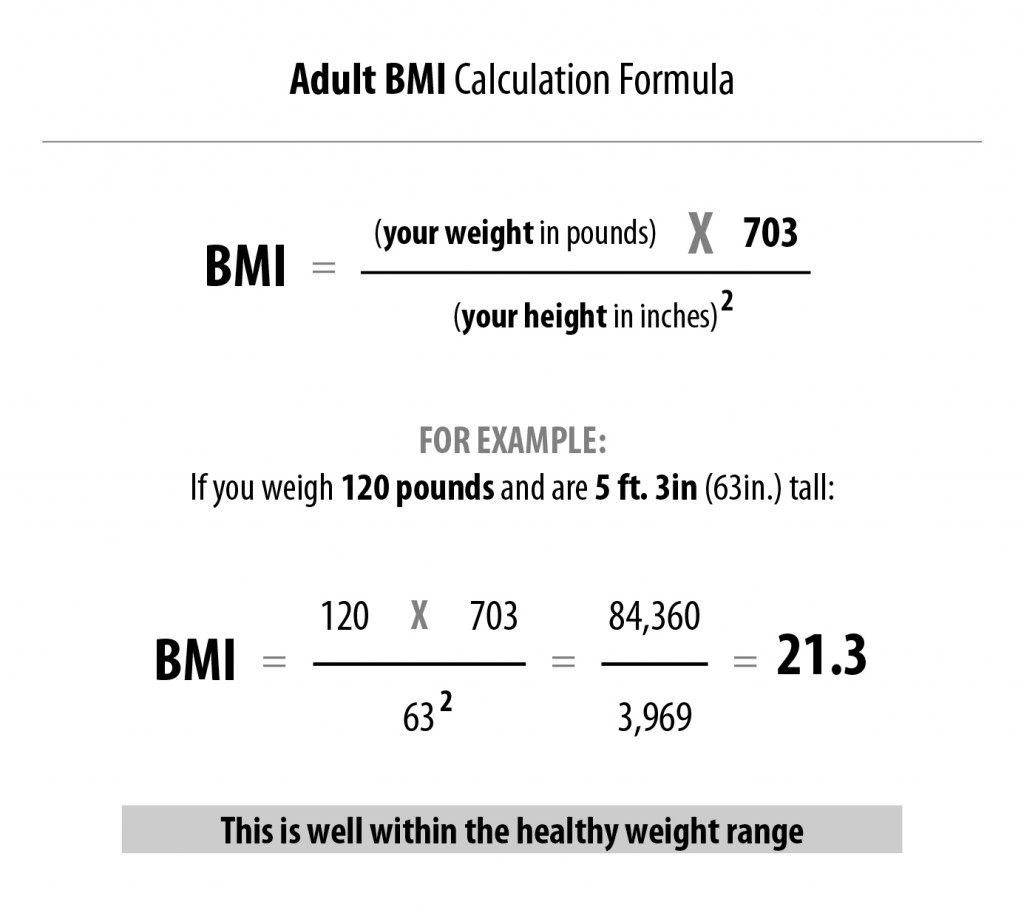
      • BMI – A common formula

      The Body Mass Index which is commonly known as BMI is used by most weight loss specialists to check for obesity levels. BMI is basically calculated by dividing your weight in kilos by your height in metres squared. Whilst this method is not foolproof and doesn’t apply correctly to bodybuilders who have large muscle mass instead of fat a BMI of above 25 classifies you as overweight with a BMI of 30-40 putting you in the obese category.

      From Wikipedia

      “The body mass index (BMI), or Quetelet index, is a measure for human body shape based on an individual’s weight and height. It was devised between 1830 and 1850 by the Belgian polymath Adolphe Quetelet during the course of developing “social physics”.” – http://en.wikipedia.org/wiki/Body_mass_index

      BMI Formula.

      [responsive]Adult BMI Formula[/responsive]

      There has been a proposal for updating the way BMI is calculated which takes into account more height extremes.

      Alternative obesity measurement.

      There is also another commonly used measurement of obesity which is to take a waist measurement of the patient. This is because fat deposits collecting around the wait area are much more linked to evenly distributed fat around the rest of the body.

      This helps take into account people who are just bigger all round and not necessarily obese. Women who have a waist measurement of 80cm or more along with men who have a waist of 94cm or more are considered more likely to develop the health problems related to obesity.

      Stats on the obesity impact in the UK.

      • 2011 data from England shows 24.8% of adults plus 16.3% of children are obese
      • 2010 data from Scotland shows 27.4% of adults plus 14% of children are obese
      • Recent Government report claimed obesity will cost the NHS £6.4bn per year by 2015

      (adult = ages 16+) (children = ages 2 -15)

      Alarming Weight Loss Statistics: UK Population Increasingly Obese

      It is predicted using Weight Loss Statistics that ½ the UK population will be clinically obese within 20 years. Around 60% of adults and 20% of school children in the EU are overweight or obese. This represents a massive increase in the last decade and it is getting worse.

      Being overweight or obese is having an excess ratio of body fat to body mass, commonly referred by BMI calculated (body mass index). A BMI of 25 is considered as healthy, whilst 25-30 is overweight and above 30 is classified as clinically obese.

      Research in the USA has shown that around 40% of cancers are attributed to obesity, largely the result of excesses of processed foods, sugar being a prime culprit.

      Obesity brings on ageing and abdominal obesity (referred to as “central obesity”) and is a precursor to heart failure, high blood pressure, raised cholesterol, stroke and sleep problems etc.,

      Reducing your weight is never easy, most weight loss diets fail through lack of determination and poor self-management. An organised approach to weight loss is needed, one based on motivation, support and the correct balance of foods.

      Over-eating is the prime aggressor of any weight loss programme and becoming overweight is caused by a conflicting situation of pleasure gained by eating more than necessary and only consuming what is required for energy on a daily basis.

      Regardless of however forceful commercial advertising implies belief in its method, the only way weight loss can be effective is by habit change to a reduction of food intake.

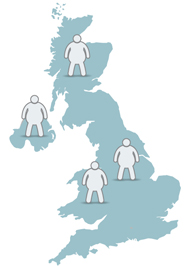
      Facts by nation

      map_obesity
      Image Credit: BMA.org

      England

      • just over a quarter of adults in England are obese
      • 3 out of 10 children aged 2 to 15 in England are overweight or obese
      • by 2050, it is estimated that half of the population in England will be obese

      Northern Ireland

      • 1 out of 5 adults is classified as obese
      • obesity and related conditions account for 20% of the health budget in Northern Ireland

      BMA Northern Ireland and the Irish Medical Organisation have produced a joint paper on obesity

      Scotland

      • two thirds of adults are overweight or obese
      • one third of children are overweight or obese
      • the cost of obesity to NHS Scotland could reach £3 billion by 2030

      Wales

      • more than half of the adult population is overweight or obese
      • 1 out of 5 children is classified as obese – the highest rate of any UK nation
      • more than a third of children are either obese or overweight

      Source:BMA.org